Powered By Blogger

Saturday, June 1, 2013

Travel Plans: One Full Body Hotel Room Exercise

I need a gym to do this exercise.

No, you do not.

Name: Overhead Snatch Squat w/ Towel Pull
Get a bathroom towel. Hold it above your head and pull out during the entire process. Raise your arms over your head. Make sure that when you raise your arms that the towel is about 4 inches above your head. Your body may mimic the shape of an upper case "Y". Brace yourself. That is, tighten your belly as if someone is about to punch you. Now, squat while squeezing your shoulder blades together, pushing the towel toward the ceiling. At the end of your squat, your wrists should face the ceiling. Upon standing, continue to hold your breath until you reach the top. See the photo below.

Targets: Shoulders, butt, quads, upper back. It's a core workout.

Parameters: 2 to 3 sets of 15. Hey, this exercise may be the only you do at the hotel.

Time to Completion: Roughly 30 to 40 seconds per set. You do have 3 minutes to do one exercise right?


Start and end position

Squat position. Sure, it could be lower.


Purpose and Development,
Derek

Derek Arledge, CSCS          TEEM Performance Training           www.teempt.com

TEEM Happenings: Photo-Op (Spring 2013)

The spring has arrived with summer on our heels, which means TEEM outdoor and travel activities have increased. Take a look at some spring action:

Athlete Work

Athlete Work

Health Seminar

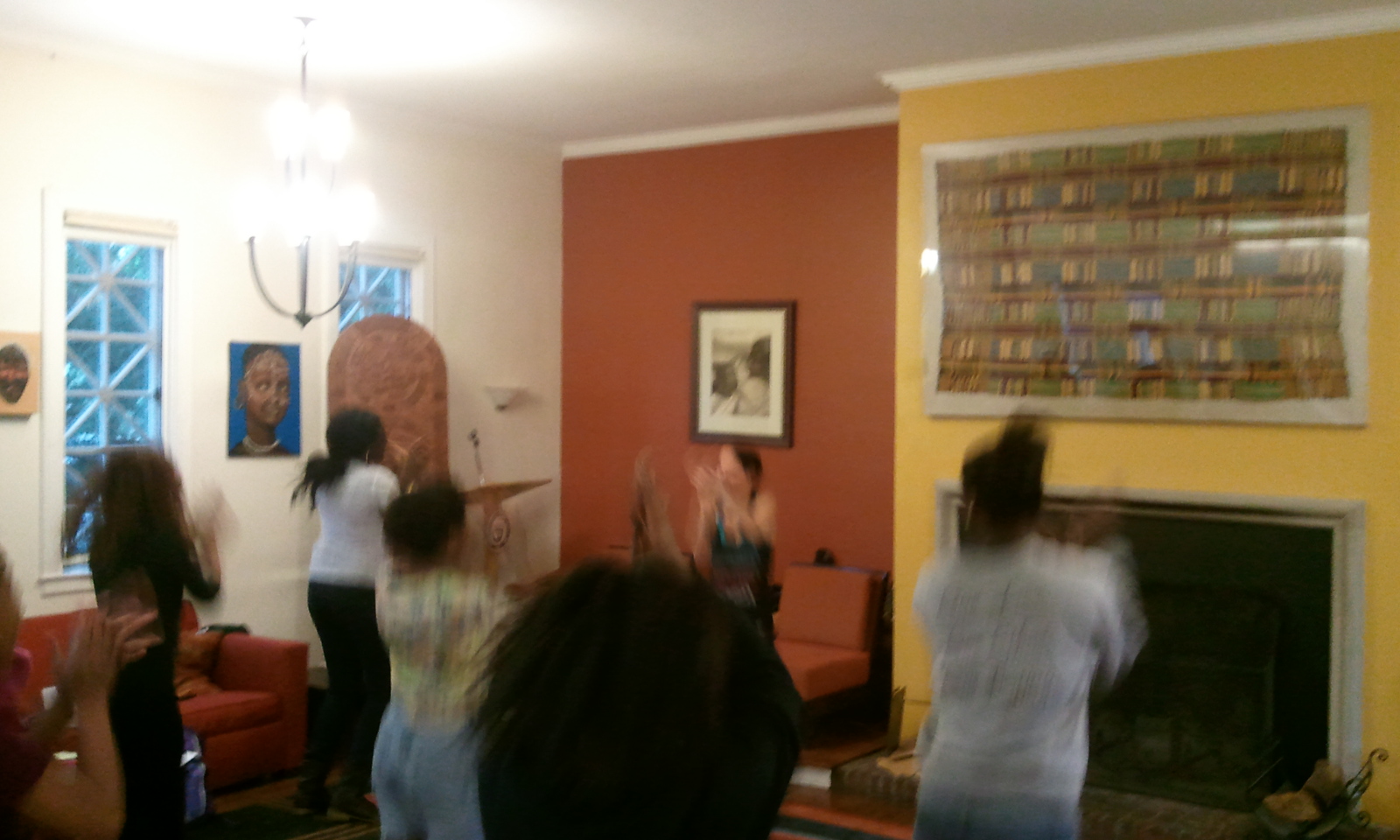
Health Seminar - Zumba

Health Seminar - Zumba (Fast Action)

Zumba - Fancy Feet

Zumba

Derek Arledge, CSCS         TEEM Performance Training          www.teempt.com

Tuesday, May 28, 2013

How Well Do You Know Your City?

Every city has a story to tell. From Los Angeles to Key Largo, FL, Western Maine, and the other large and small cities. There are plenty of things to learn about a city. But, this message is not solely referring to a city's establishment age or what the settlers did hundreds of years ago.

"How well do you know the city in which you live?"

Basically, have you ever traversed your city on foot, on a bike, or on something else other than public transportation or in a motor vehicle? If you can answer, "yes", then you know that seeing your city or any other city in this manner is better than taking a motorized tour. Wait, I forgot the Segway. The Segway counts as a legitimate guide. So, what do you get when you expend physical energy around your city?

1. You learn about resources that you never knew existed. Resources include buildings, playgrounds, fields, schools, courts, stadiums, water ways, parks, parking lots...someone stop me before I keep on going. All of these resources present ways to receive exercise.

2. You see the true sites, sounds, and behaviors of the city. Bike down a neighborhood street and hear the sound of kids or adults playing basketball. Warning: I cannot guarantee that all language will be rated G. Hear the sound of a stroller as the parent runs behind it. See how dogs interact with one another. Watch someone perform T'ai Chi. These activities are some of the sites, sounds, and behaviors that you will notice. It's...catchy.

3. You learn about the hot hub areas. You know that one park in your area that you thought was very quiet? Yea, right it's quiet. It is a bustling place in the morning, after work, and on the weekend. The warmer weather sure does bring everyone out of the wood-works.

4. You learn about fun, free, and discounted stuff. I remember testing out my current bike a couple of years ago, and riding through an adjacent city that has more hills. I love hills. However, on my way toward the hills, I came across a festival that I had never heard of in the past. At this particular festival were restaurants that showcased their foods, fluffer-nutter (that is, peanut butter and marshmallow sandwich). The entertainment on the street included music and roller derby athletes. Very interesting. There might be something around your neighborhood of which you have no idea about its existence. Get on it!

5. You realize that restaurants to which you would travel are closer than the one restaurant to which you currently travel because you did not know about the cool strip of restaurants within walking distance. By the way, walking distance in this case is roughly 2 miles one way, depending on the person. Take note that restaurants change locations or names faster than gyms and churches.

With everything mentioned here, take advantage of the nice weather. Do not get cramped indoors. Love you some vitamin D and get to know your city a little better.

Doesn't every city have those hubway bicycle racks everywhere now?...Except Los Angeles?

Purpose and Development,
Derek

Derek Arledge, CSCS        TEEM Performance Training         www.teempt.com

The Cookout - Feast Artist

In this first weekend of the 2013 Cookout Season (Memorial Day Weekend to Labor Day Weekend), we can point out whose potato salad is good, who grills the best, and who makes the most interesting dishes among other categories. Well, let's get a 10-list going. Below are 10 summer foods to try, 10 unsung summer sports to try, and 10 activities to try (no specific order as these lists are not rankings):

Foods
10. Potato salad made with different ingredients than normal (different = as healthy as possible)
9. Bison burgers
8. Cole Slaw (same directions as potato salad)
7. Stuffed __________
6. Lamb
5. Baked Beans with a little different sauce
4. Deviled Eggs (Angel eggs as they are also called) with hummus
3. A veggie/green mix other than romaine or iceberg lettuce
2. Fish
1. Crabs (That's the Marylander in me coming out. We love crabs and Old Bay seasoning!)

Sports
10. Soccer
9. Mountain Biking
8. Orienteering
7. Cricket
6. Golf
5. Tennis
4. Ultimate Frisbee
3. Sand/Backyard Volleyball
2. Softball/Baseball
1. Basketball - even if it is simply for the sake of just standing and shooting
Bonus: Family dodgeball

Activities
10. Camping
9. Hiking
8. Sailing
7. Four Square
6. Canoeing/Kayaking/Rowing
5. Rollerblading
4. Square Dancing
3. Rock Climbing
2. Trampoline Jumping (at your own risk)
1. Hop-Scotch

Purpose and Development,
Derek

Derek Arledge, CSCS          TEEM Performance Training          www.teempt.com


Friday, May 24, 2013

Physical Rehabilitaion Activity

A few words come to mind when thinking about physical rehabilitation: minor setback, modification, training, and consistency to name a few.
 
Minor setback – Depending on the severity of the injury, the setback may last for 24 hours, one month, one year, or other.  The good news says that every injury can be managed.
 
Modification – During post-rehabilitation of an injury, you may have to adjust how you perform. For example, instead of performing squats through its full range of motion, which may aggravate your injured knee, performing squats with a yoga block on top of a chair aids in range of motion, strength, and proprioception. Also, instead of doing crunches to come back from an abdominal injury sustained while running you may have to perform isometric abs exercises while standing to re-emphasize the muscular patterns around the abdominal region in a functional manner.
 
Training – But never stop training. Training is not simply physical. It is mental as well. Imagine yourself returning from your injury stronger than before. More flexible than before. Of course, all of this shall come gradually and in due time. If you cannot take direct impact to your joints as in a lower body injury, then certain cardiovascular exercises are important. The bicycle, heavy ropes, and swimming are helpful.
 
Consistency – Skipping out on rehabilitation work puts you further back in your comeback. Many rehabilitation protocols can be carried out at home. Of course, it helps to get out to a gym with a rehab program in hand. But, with the correct amount of space, knowledge, and exercise “toys”, some sound physical rehabilitation can be accomplished on a consistent basis.
 
As the summer approaches, hopefully everyone can free themselves of injuries. If you are nursing one now. Stay with the program. Then, build upon it.
 
Purpose and Development,
Derek
 
Derek Arledge, CSCS           TEEM Performance Training           www.teempt.com

Fat Swagger - Blood Diamond

Did you know that there is a fat swagger meter. Well, it is nothing that you will find on Google. It is actually an internal meter. The fat swagger meter is how you carry around your adipose tissue. Do you name it? Does it get in the way? Seriously, at one point in my life, I named my stomach fat, “Jeffrey”. Yes…yes, I did. I figured that if the extra little fat wanted to exist, then it had to be named in order to be, well, burned. In the past, I have mentioned to other individuals on a humorous level to name certain fat areas. From this experience, I learned that laughter is definitely medicine and common names like “Jeffrey” are, well, common. In its essence, fat gives you some swag. Swag is a type of positive attitude (see: Athletic Swag entry). A positive attitude toward something like fat eventually helps you to decrease the amount of worry and to appropriately work off the fat . It is especially good to have it around the holidays.
 
That is, a positive attitude.
 
Our anatomy possess its own fat swagger. It likes to sit in certain places. It can, however, be mobilized with exercise. Yet, when it is not mobilized blood circulation tends to decrease. Your heart feels the results as it asks you, “hey, where is the blood?” Stomach fat, in this case, is the most detrimental. We cannot see it, but your stomach and pelvis areas make up important vessel bifurcations in addition to hosting important organs and muscles. So, if these organs and muscles are getting all of the love, then what is the heart getting? (see: Summer Tempo and Lower Abdominal Fat ). If the heart is not receiving its share of a positive attitude, then the rest of the body will suffer, including the organs that encompass the abdomen. They must work extremely hard in this circumstance.
 
Special Note: It is cookout season (Memorial Day to Labor Day), which means that all sorts of fun will happen for many individuals. Now, you do not have to discourage yourself. However, do encourage yourself to enjoy what you eat. Just eat to move. Personally, I know that I will eat anything from hamburgers to cake during this season. I also know that there is a limit. Therefore, everyone is encouraged to explore but set boundaries. Please, set some boundaries – you will enjoy the food even more. Lastly, here is a challenge: how many healthy and good cookout foods can you make?

Purpose and Development,
Derek

Derek Arledge, CSCS          TEEM Performance Training          www.teempt.com

Tuesday, May 21, 2013

Cycle for Your Glutes

Get it. The weather is warming up, which means paths and trails will be congested, especially on the weekends. But, there is an activity that is easy to do one you have learned and fun to learn how to do. It is easier on your joints, faster than Usain Bolt for a longer period of time. The activity requires something in itself that can be deemed low maintenance or high maintenance. Lastly, it has many names. Ready?

Cycling, bicycling, biking.

No, not spinning. Spinning is an indoor or outdoor activity that only requires stationary miles.

Break out the Specialized, Jamis, and Bianchi two-wheelers!

Honestly, in the summertime people like to look good in shorts, Capri's, swimsuits, etc. So, why not work on your glutes in a fashion that also sculpts your legs? There have been numerous studies involving bicycling. Very, very positive studies. Most of them may point out that our glutes/butt increase strength, increase power, or even lose fat. Because the thigh is included in this activity, the skirt department at Bloomingdale's shall be most popular among Schwinn and Cannondale owners.

Bike rides with hills in them are more appropriate for a very solid burn. However, if you have not biked in years, then get ready for a burn on a shorter ride. No worries because all of the burning that occurs is dedicated to building more energy. It means your energy systems are working. Below is a brief list for bikers (non-commuting). The parameters are only relative. For example, you may be a beginner and love a long ride:

Beginners: 10 miles, flat terrain

Intermediate: Short to trek it. Look out for the hills. You may still be counting them in your head - 20 to 30 miles with moderate intensity.

Advanced: Trek it. Go for the long miles with hills - 30+ miles with moderate to high intensity.

Purpose and Development,
Derek

Derek Arledge, CSCS         TEEM Performance Training          www.teempt.com